Citizens Republic Bancorp (CRBC) is a large bank in Michigan, with deposits and loans all over the Upper Midwest States, and today it announced it was raising $200 million in capital to bolster its balance sheet. The bank also announced that it was transferring $131.4 million of non performing loans in its portfolio to "held for sale," on its balance sheet. The breakdown by category is:
Land Construction and Development - $59.2 million.
Other CRE - $26.8 million.
Residential Mortgage - $45.4 million.
According to the problem bank guide published by the Office of the Comptroller of the Currency, when loans are transferred to this category, "the transfer to the HFS account must be made at the lower of cost or fair value in the period in which the decision to sell is made."
The amounts written off, and the percent when the loans were marked to market was:
Land Construction and Development - $11.60 million, or 19.6%.
Other CRE - $6.50 million, or 24.3%.
Residential Mortgage - $20.40 million, or 44.9%.
The average writedown was 29.3%.
These writedowns reflect the reality of what is occurring out there, although many banks are reluctant to take this step and write down loans. When a bank delays doing this, it gives an artificial view of of a bank's capital position. I applaud CRBC for taking the actions they did. Many other banks will follow over the next year.
CRBC also gave a forecast for the balance of 2008 on credit losses. The bank estimated net charge offs at a range of $79.0 million at the low end, up to $163.0 million in a worst case stress scenario.
The stock has had a rough last year, as can be seen in the chart below.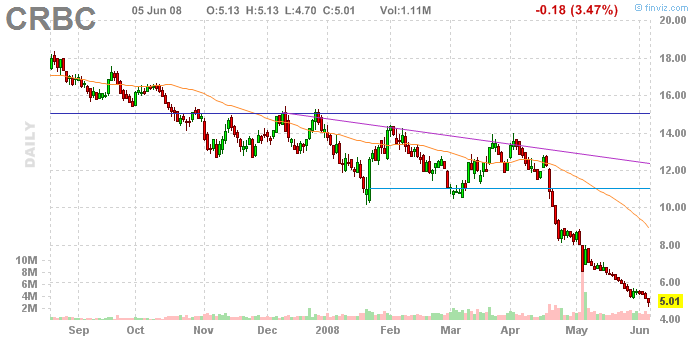
Disclosure - I am short this stock.
Thursday, June 5, 2008
One Bank Throws in the Towel

Friday, April 4, 2008
Games Banks Play - Number Five
Over the next couple of years, many banks will fail and be taken over by the government or larger institutions. This will be an agonizing process that some banks will try to avoid at any cost. I will explain in a multi part series what to watch out for:
There are strict requirements regarding the sale of OREO by Banks in terms of the cash down payment by the buyer. FASB 66 states that:
"The buyer's initial investment shall include only:
(a) cash paid as a down payment.
(b) the buyer's notes supported by irrevocable letters of credit from an independent established lending institution.
(c) payments by the buyer to third parties to reduce existing indebtedness on the property.
(d) other amounts paid by the buyer that are part of the sales value."
Banks cannot lend money to the buyer to finance the purchase of OREO - or as the Comptroller of the Currency has put it:
"The cash down payment requirement of FAS 66 can be satisfied only with the borrower’s personal funds, funds borrowed from an unrelated source, or an irrevocable letter of credit from a third party. This requirement for a cash down payment generally is not met when a bank provides the borrower with an additional loan for working capital or when the borrower’s down payment is obtained by draws on an unrelated line of credit with the bank."
Part One
Part Two
Part Three
Part Four
Friday, February 1, 2008
Dugan Speech
John C. Dugan is the Comptroller of the Currency, and yesterday he gave a speech to the Florida Bankers Association. The Office of the Comptroller of the Currency (OCC) is but one of five regulators of banks in the United States. The five are:
The Office of the Comptroller of the Currency (charters, regulates, and supervises all national banks. It also supervises the federal branches and agencies of foreign banks)
Federal Reserve Board (state chartered banks that are members of the Federal Reserve System and bank holding companies)
Federal Deposit Insurance Corporation (insured state banks that are not members of the Federal Reserve System)
Office of Thrift Supervision (savings and loans)
National Credit Union Administration (credit unions)
Dugan mentioned some interesting information regarding banks and the risks they face.
1) The ratio of commercial real estate loans to capital has nearly doubled in the past six years, to 285 percent.
2) Over a third of the nation’s community banks have commercial real estate concentrations exceeding 300 percent of their capital, and almost 30 percent have construction and development loans exceeding 100 percent of capital.
3) Over 60 percent of Florida banks have CRE loans exceeding 300 percent of capital, and more than half have C&D loans exceeding 100 percent of capital.
4) Indeed, during the past year national community banks have experienced a significant increase in nonperforming C&D loans. As of Sept 30, these loans amounted to 1.96 percent of total C&D loans, a rate that was more than twice that of a year earlier.
5) In Florida, that trend is even more pronounced. While nonperforming loans a year ago were 40 basis points less than the national average, the figure has increased to 3.34 percent of total C&D loans. That’s 70 percent greater than the national average and an almost eight-fold increase in one year.
6) Thus far overall nonperforming CRE loans, even in the area of residential construction and development lending, are a long way from approaching historical peaks.
It should be a fun year for the Banking Industry.


